
Temporal Serverless Workers on Cloud Run: Scale workers ahead of demand
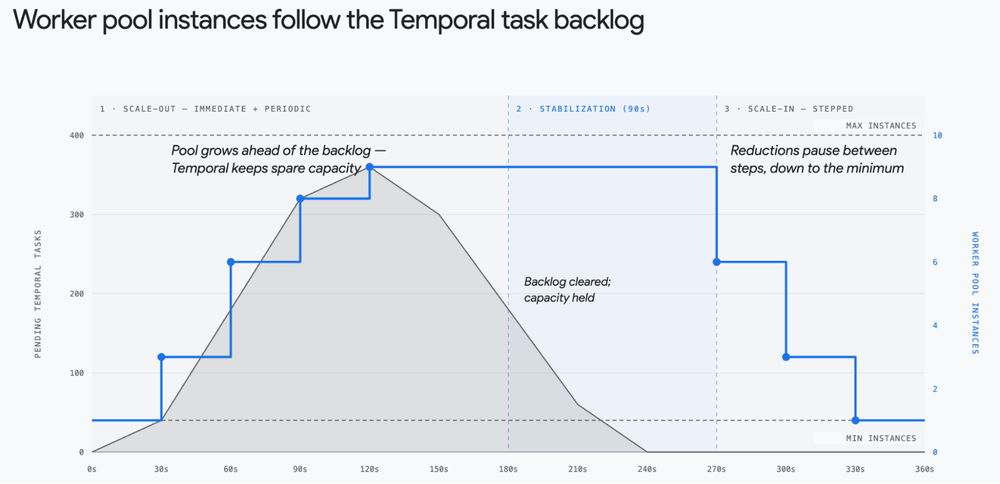
The open-source Temporal execution platform is rapidly becoming a foundational layer of modern software infrastructure — especially for orchestration in distributed systems and AI agent workloads. However, deploying and scaling workers in Temporal comes with unique challenges.
The open-source Temporal execution platform is rapidly becoming a foundational layer of modern software infrastructure — especially for orchestration in distributed systems and AI agent workloads. However, deploying and scaling workers in Temporal comes with unique challenges.
We built Cloud Run worker pools for exactly this kind of pull-based work: Your instances connect to a queue or stream, take the next item, and process it. Starting today, Temporal Cloud, which is the fully managed version of Temporal’s open-source platform, can scale them for you. Currently in preview, Temporal Serverless Workers on Cloud Run let you deploy your workers as a worker pool, and Temporal sizes the pool to match the work on your task queues. When there's no work, it can scale the pool to zero. There's no cluster or autoscaler to run, and your worker code stays the same.
How Cloud Run worker pools fit with Temporal A worker pool is Cloud Run's resource for continuous background work. It has no public endpoint, and each instance is allocated CPU for its whole lifetime, which matches how a Temporal worker runs. Temporal manages your Cloud Run worker pools as follows:
Your Temporal workers run as Cloud Run worker pool instances in your project and poll Temporal Cloud for tasks.
Temporal Cloud tracks your task queues and sets the worker pool's instance count through the Cloud Run Admin API, using the IAM permissions you grant. Temporal never opens a connection to your instances, so you don't need to open ports or add firewall rules for it.
You run each build version as its own Cloud Run worker pool. An older build's worker pool can sit at zero instances until a workflow that started on it needs it again.
In context
- Topic: Cloud y Arquitectura — Nube pública, híbrida, costos y decisiones de infraestructura.
- Source: Google Cloud Blog
- Published: 15/10/2026
Continue reading at the original source →
Excerpt published automatically by the site radar. The full text belongs to its publisher and is linked above.
Why it matters
After a few years, nearly every organisation that migrated discovers the same thing: the bill grows faster than the business. Not because the cloud is expensive, but because nobody switches off what is no longer used and nobody has the incentive to check.
What I look at in these announcements is portability. The more comfortable a platform is, the harder it usually is to leave, and that comfort gets paid for in negotiating power three years later, exactly when renewal comes up and there is no credible alternative left.
What usually goes wrong
Where it usually breaks is team capability. The platform is new but people learned on the fly, with no time and no support. They end up replicating data-centre practices in the cloud, which means paying cloud prices for benefits that never arrive.
What to watch
- Who sees the bill and in what detail: with no owner for the spend, the spend grows on its own.
- Where the data physically sits and what local regulation demands about that.
- What happens when the provider has an outage, because it will, and what keeps running meanwhile.
How I read this entry
I would read it thinking about the exit before the entry. Not because anyone plans to leave, but because the conversation about how you would leave is the one that reveals how much you are locking in. If nobody at the table can describe that path, the dependency is already deeper than they think.
This entry is an excerpt from the original source, selected by the site radar. The commentary above is the site's own and does not belong to the cited publisher.
Comments
No comments yet. Yours can be the first.
Living through this in your own team?
Open the chat and tell me how you're handling it. I'm interested in comparing notes.