The same Scrum framework sits behind organisations that get real value from AI and those that don't. What separates them is where Scrum is placed in their operating model.
The same Scrum framework sits behind organisations that get real value from AI and those that don't. What separates them is where Scrum is placed in their operating model.
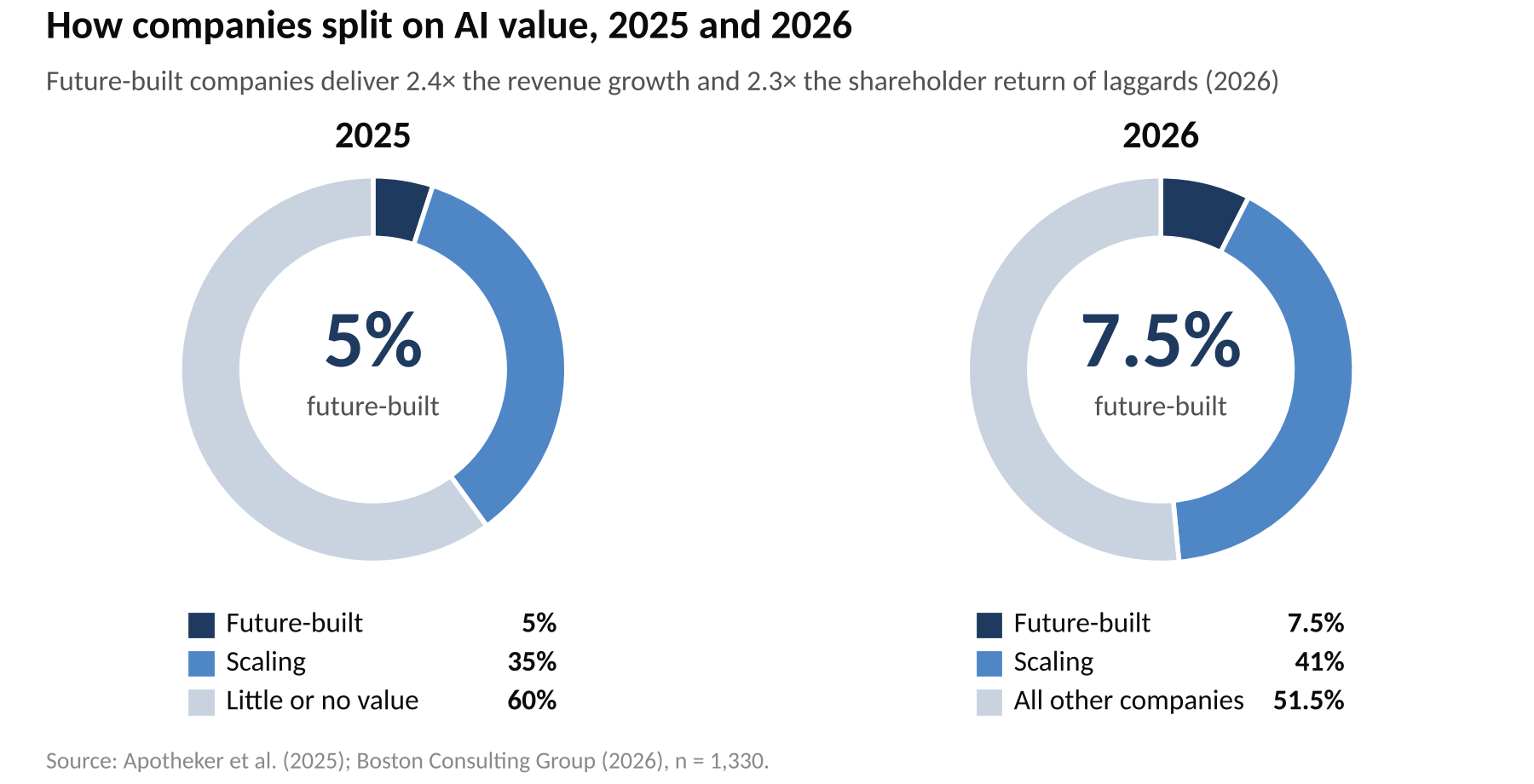
Governance separates AI leaders from laggardsBoston Consulting Group's 2025 research found that 5% of companies were "future-built" for AI, 35% were scaling it, and 60% were getting little to no material value despite substantial investment (Apotheker et al., 2025). The 2026 follow-up, a survey of 1,330 senior leaders, puts future-built companies at 7.5% and scalers at 41%; future-built companies deliver 2.4 times the revenue growth and 2.3 times the total shareholder return of laggards (Boston Consulting Group [BCG], 2026). BCG describes its leaders in operating-model terms: they reshape end-to-end workflows, invest in governance alongside technology, and measure impact directly in their profit and loss (BCG, 2026).
DORA's 2025 research reaches the same point from the engineering side. AI's main effect on software delivery is amplification: it strengthens organisations that already work well and worsens the problems of those that do not (DeBellis et al., 2025).
BCG's measures are commercial, but the mechanism is the same in the public sector, where funding either follows evidence of outcomes for citizens or follows the original business case. Used that way, Scrum governs the organisation's AI investment, rather than serving as a delivery process that needs a separate AI control layer on top.
Scrum as a delivery methodMost Scrum Masters will recognise this pattern. A business case is approved with fixed scope and forecast benefits. The Product Owner receives a requirements document and translates it into Product Backlog items, and reordering those items requires a change request to a project board. The Sprint Review becomes a demonstration to a steering committee that makes funding decisions elsewhere on a quarterly cycle. "Done" means a stage gate has been passed.
In context
- Topic: Proyectos, PMO y Riesgos — Gestión de proyectos, oficinas de proyecto y riesgo del portafolio.
- Source: Scrum.org
- Published: 13/10/2026
Continue reading at the original source →
Excerpt published automatically by the site radar. The full text belongs to its publisher and is linked above.
Por que importa
Em gestão de projetos, quase tudo o que se discute como problema técnico é na verdade um problema de expectativas mal negociadas no começo. Escopo, prazo e custo foram acordados num momento em que ninguém tinha informação suficiente, e depois ninguém quis reabrir a conversa.
Meu filtro é a qualidade do relatório de status. Se todos os projetos estão em verde, o sistema de informação não serve: em qualquer portfólio real há iniciativas com problema, e uma organização saudável as mostra a tempo em vez de descobri-las no comitê de encerramento.
O que costuma dar errado
O erro clássico é tratar a gestão de riscos como entregável da fase de planejamento. Monta-se a matriz, aprova-se, arquiva-se. Ninguém a reabre até o encerramento, quando serve para documentar que o risco estava previsto — que é exatamente o contrário de gerenciá-lo.
O que observar
- Se o relatório de status mostra projetos em vermelho: um portfólio todo verde é um portfólio sem informação.
- Quais riscos estão identificados, quem é dono de cada um e quando foram revisados pela última vez.
- O tamanho da primeira entrega útil: quanto mais longe estiver, mais se parece com uma aposta.
Como leio esta publicação
Se isto chegasse à minha mesa, a primeira coisa que eu pediria não é o avanço percentual: é a lista de decisões pendentes com nome e data. O percentual dá para maquiar; uma decisão travada há três semanas com um responsável identificado não dá para discutir, e explica o atraso muito melhor.
A notícia original está publicada em outro idioma; o trecho é citado como o veículo o entrega e o comentário é escrito em português.
Comentários
Ainda não há comentários. O primeiro pode ser o seu.
Está vivendo isso na sua equipe?
Abra o chat e me conte como estão lidando com isso. Tenho interesse em comparar notas.