
The same Scrum framework sits behind organisations that get real value from AI and those that don't. What separates them is where Scrum is placed in their operating model.
The same Scrum framework sits behind organisations that get real value from AI and those that don't. What separates them is where Scrum is placed in their operating model.
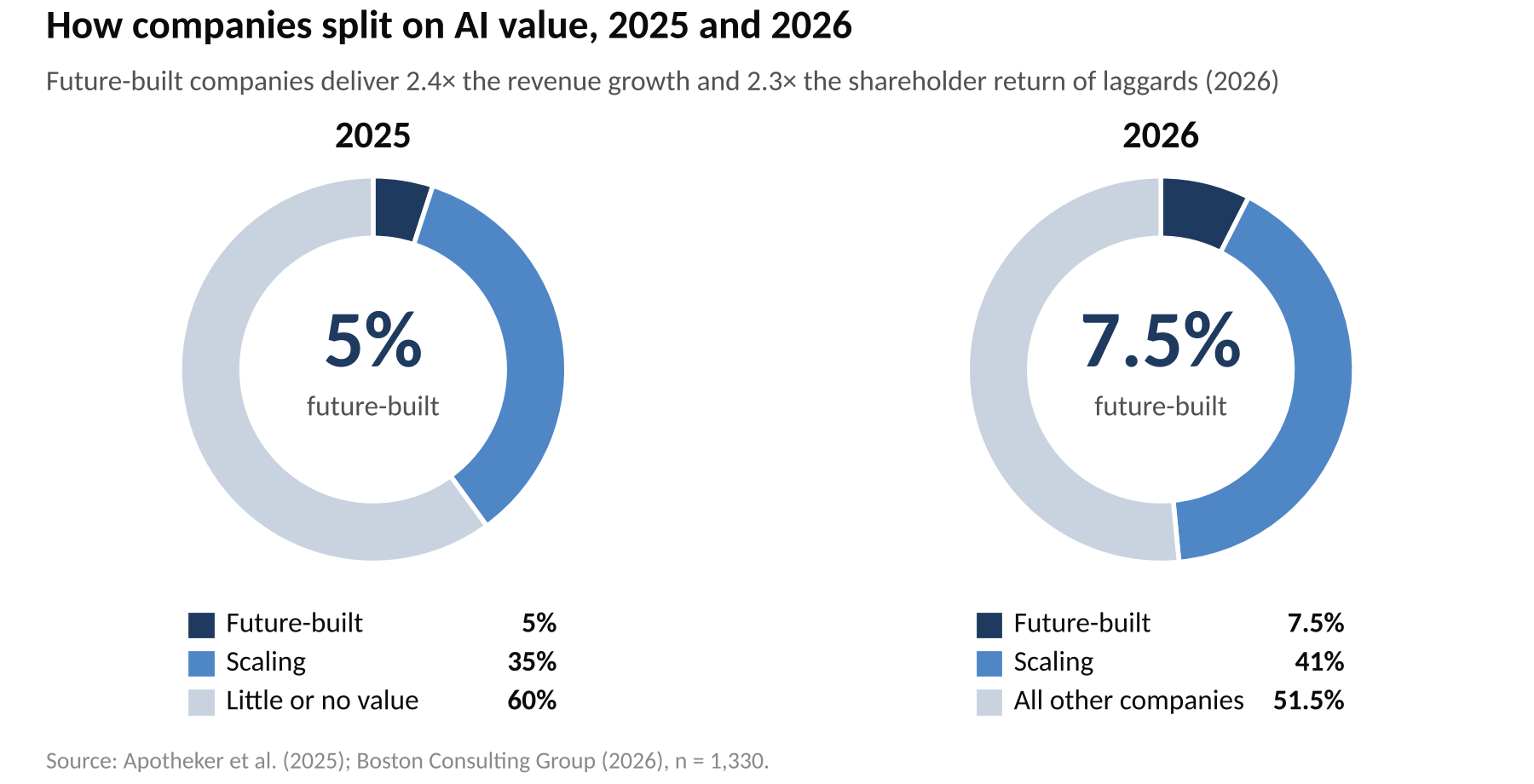
Governance separates AI leaders from laggardsBoston Consulting Group's 2025 research found that 5% of companies were "future-built" for AI, 35% were scaling it, and 60% were getting little to no material value despite substantial investment (Apotheker et al., 2025). The 2026 follow-up, a survey of 1,330 senior leaders, puts future-built companies at 7.5% and scalers at 41%; future-built companies deliver 2.4 times the revenue growth and 2.3 times the total shareholder return of laggards (Boston Consulting Group [BCG], 2026). BCG describes its leaders in operating-model terms: they reshape end-to-end workflows, invest in governance alongside technology, and measure impact directly in their profit and loss (BCG, 2026).
DORA's 2025 research reaches the same point from the engineering side. AI's main effect on software delivery is amplification: it strengthens organisations that already work well and worsens the problems of those that do not (DeBellis et al., 2025).
BCG's measures are commercial, but the mechanism is the same in the public sector, where funding either follows evidence of outcomes for citizens or follows the original business case. Used that way, Scrum governs the organisation's AI investment, rather than serving as a delivery process that needs a separate AI control layer on top.
Scrum as a delivery methodMost Scrum Masters will recognise this pattern. A business case is approved with fixed scope and forecast benefits. The Product Owner receives a requirements document and translates it into Product Backlog items, and reordering those items requires a change request to a project board. The Sprint Review becomes a demonstration to a steering committee that makes funding decisions elsewhere on a quarterly cycle. "Done" means a stage gate has been passed.
In context
- Topic: Proyectos, PMO y Riesgos — Gestión de proyectos, oficinas de proyecto y riesgo del portafolio.
- Source: Scrum.org
- Published: 13/10/2026
Continue reading at the original source →
Excerpt published automatically by the site radar. The full text belongs to its publisher and is linked above.
Why it matters
In project management, nearly everything discussed as a technical problem is really a problem of expectations badly negotiated at the start. Scope, time and cost were agreed at a moment when nobody had enough information, and afterwards nobody wanted to reopen the conversation.
My filter is the quality of the status report. If every project is green, the reporting system is not working: in any real portfolio some initiatives are in trouble, and a healthy organisation surfaces them in time rather than discovering them at the closure committee.
What usually goes wrong
The classic mistake is treating risk management as a deliverable of the planning phase. The matrix gets built, approved, filed. Nobody opens it again until closure, when it serves to document that the risk was foreseen — which is exactly the opposite of managing it.
What to watch
- Whether the status report shows any red projects: an all-green portfolio is a portfolio without information.
- Which risks are identified, who owns each one, and when they were last reviewed.
- The size of the first useful delivery: the further out it is, the more it resembles a bet.
How I read this entry
If this landed on my desk, the first thing I would ask for is not percentage complete: it is the list of pending decisions with a name and a date. A percentage can be dressed up; a decision stuck for three weeks with an identified owner cannot be argued with, and it explains the delay far better.
This entry is an excerpt from the original source, selected by the site radar. The commentary above is the site's own and does not belong to the cited publisher.
Comments
No comments yet. Yours can be the first.
Living through this in your own team?
Open the chat and tell me how you're handling it. I'm interested in comparing notes.